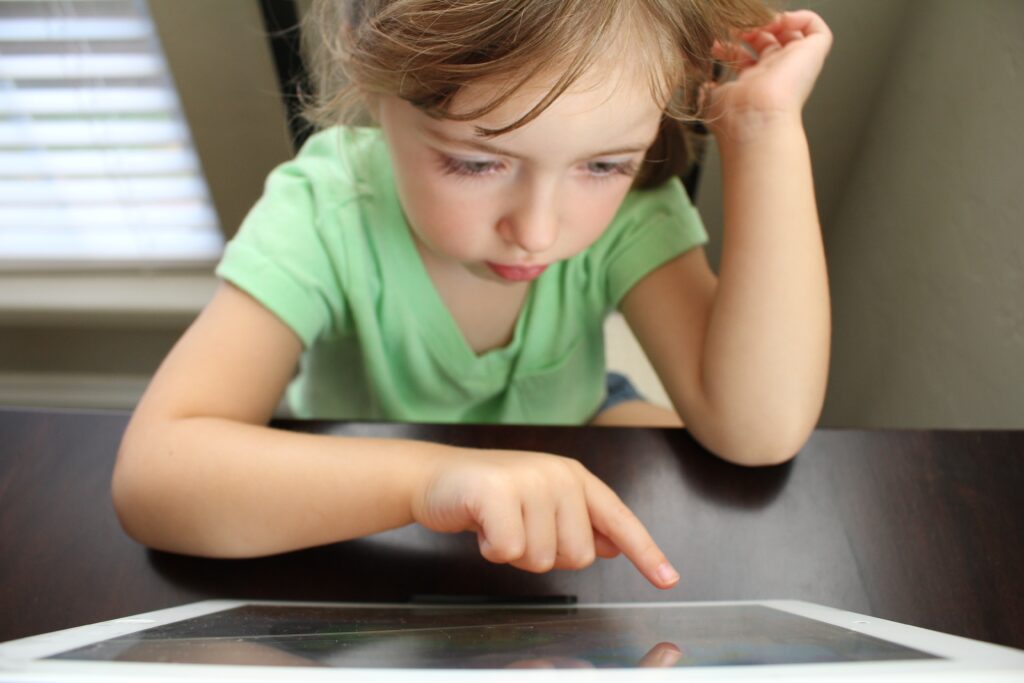
Nobody hands new parents a manual before that first screen moment. One day there is a phone, a tablet or a TV remote, and a small, curious hand reaching for it, and most of us are making it up as we go.
That is completely normal. It is also why so many parents figure these five things out only after the fact, usually somewhere around the second or third screen session, not the first.
Here they are a little earlier than most of us got them.
1. There Is A Real “Too Early”
It is tempting to think of screen time as something to figure out once a child is a bit older. In practice, most major paediatric and public health guidelines are fairly specific about the early years:
- Screens are best avoided before 18-24 months, aside from things like video calls with family.
- Between roughly ages 2 and 5, the general advice is to keep screen time limited, often treated as an hour a day at most, not a target to aim for.
- Under about age 5, a young child should not be left alone with a screen. Having an adult nearby who can explain what is happening and check in on the child makes a real difference.
None of this means a two-year-old glancing at a video call with grandparents is a problem. It means the blanket idea of “screens are fine once they’re old enough to sit still” tends to arrive later than most families expect, and supervision matters for longer than people assume.
2. Pace Matters More Than Most Parents Realise
This is the one that surprises people most. It is not really about how much a child watches. It is about how the content itself is built.
A lot of videos aimed at toddlers are edited with rapid cuts, a character shown from the front, then the side, then from behind, all within a few seconds. Add intensely saturated colours and near-constant motion, and you get a combination that is very good at holding a young child’s attention and asks almost nothing of their brain except to keep watching.
This pattern shows up constantly in content marketed as “educational” for toddlers, especially on open platforms with autoplay and algorithm-driven recommendations. The label on the video rarely tells you much about its pace.
A simple test: if the content feels a little slow or even mildly boring to you as an adult, that is often a good sign for a young child. The calmer the pace, the more room there is for a child to actually process what they are seeing instead of just reacting to it.
3. There Are A Few Simple Signs Of Safe Content
You do not need to become a media expert to sort the calm content from the chaotic content. A handful of signs tend to say more than any age label or app store description.
Worth checking before you hand something over:
- How many things are competing for attention at once. Fewer loud sound effects, fewer flashing or moving elements on screen at the same time, and calmer colour palettes all help a young child actually focus on one idea instead of being pulled in five directions.
- How intense the colours are. Deeply saturated, high-contrast colour schemes are often a sign that something is designed to grab attention rather than to teach.
- Whether the recommendation system is open or closed. An endless, algorithm-driven feed with unlimited related videos removes the natural stopping point a shorter, closed activity would have, and it is rarely curated with a young child’s attention span in mind.
- Whether the dialogue and ideas are actually simple. Content built for young children should use plain language and clear, age-appropriate ideas, not clever wordplay or fast-moving plots aimed more at older siblings or adults watching along.
A closed, ad-free app built with teachers and child development specialists tends to score well on all four of these almost by design. ALPA Kids, an educational app for children aged 3-8, is one example: a limited, age-matched set of games instead of infinite scrolling, calmer colour choices instead of high-saturation visuals, and no autoplay feed pulling a child toward whatever comes next.
None of this requires a checklist taped to the fridge. It mostly means slowing down enough, the first few times, to actually notice what is competing for your child’s attention.
4. Not All Screen Time Is Created Equal
This is the idea that quietly undoes most screen time advice built around a single number. “One hour a day” sounds like a clear rule, but an hour can mean wildly different things depending on what fills it.
An hour of autoplay video, one loud clip sliding into the next with no natural stopping point, is not the same hour as one spent listening to a story, choosing an answer, matching a picture to a word and trying again after a small mistake. Same device, same sixty minutes on the clock, completely different experience for a developing brain.
The setting matters too. A quiet corner with an adult nearby and a loud living room with the TV running in the background as background noise produce very different versions of “screen time,” even with identical content.
This is worth remembering the next time screen time gets reduced to a single number in your head. The honest question is rarely just “how long?” It is closer to “what kind, with whom, and in what kind of moment?”
5. Active Beats Passive, Every Time
This is the tip that changes the most once parents actually notice it. There is a real difference between a child who is watching something happen and a child who is doing something.
Passive content asks almost nothing of a child: watch this, swipe to the next one, repeat. Active content asks them to participate: listen to a word and match it to a picture, choose the right shape, remember a pattern, try again after a small mistake. That second kind tends to build language, memory, attention and confidence in a way passive watching simply does not.
This is one of the main ideas ALPA Kids was built around: children are not just watching a screen, they are listening, choosing, solving and trying again, in a calm, ad-free space designed with teachers rather than an advertising algorithm in mind.
A simple way to check which kind of screen time is in front of your child: does it ask them to do anything at all? If the honest answer is no, that is worth noticing.
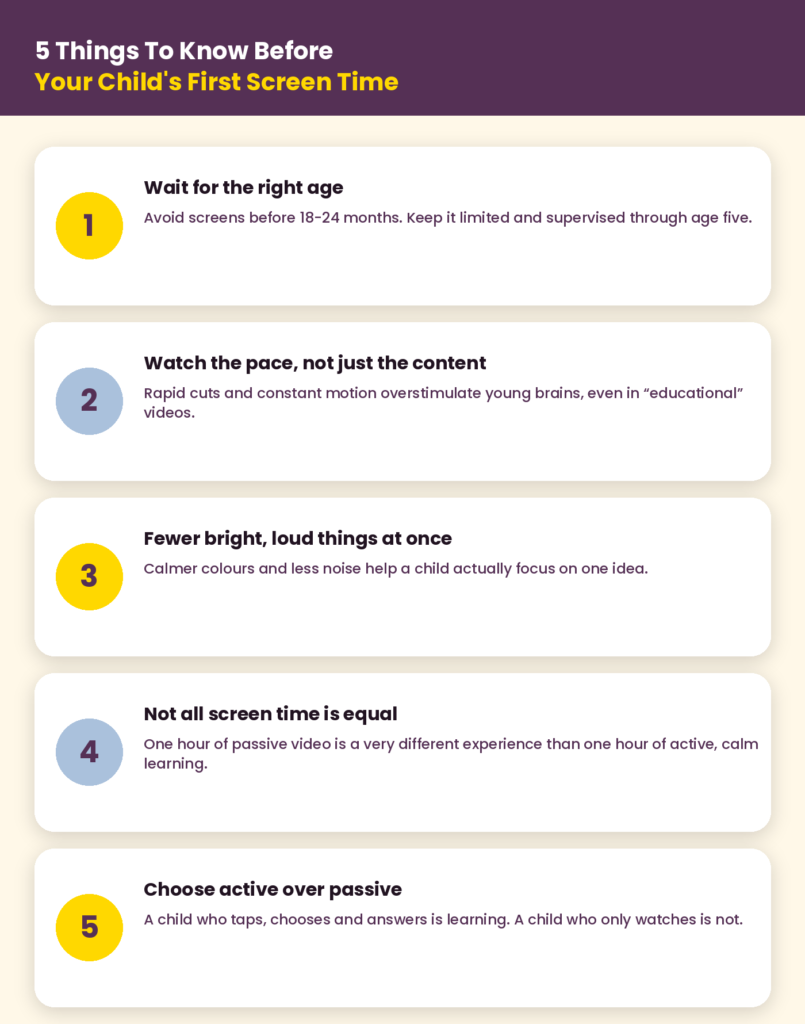
Putting It All Together
None of these five things require becoming a screen time expert overnight. They mostly come down to slowing down for the first few minutes: checking the age fit, watching the pace, looking past the “educational” label, previewing for anything frightening, and noticing whether your child is doing something or just watching.
Get those right early, and most of the rest tends to sort itself out.
A Gentle Next Step
If you are looking for a calm first educational app to try, ALPA Kids offers a free plan with a smaller selection of games, so you can see how your child responds before deciding whether to explore further.
No pressure, no perfect system required. Just a slightly more informed first step than most of us got.
FAQ Section
At what age can children start having screen time?
Most major guidelines suggest avoiding screens before 18-24 months, aside from things like video calls, and keeping screen time limited and supervised between roughly ages 2 and 5.
Why does the pace of a video or app matter so much for young children?
Rapid cuts, constant motion and highly saturated colours can overstimulate a young child and hold their attention without engaging their thinking. Calmer pacing gives children room to actually process what they see.
What are the signs of safe, good-quality content for young children?
Look for a calm number of things happening on screen at once, softer rather than highly saturated colours, simple dialogue and ideas, and a closed selection of content rather than an endless, algorithm-driven recommendation feed.
Does it matter what kind of screen time my child gets, not just how much?
Yes. An hour of passive, autoplay video is a very different experience for a child than an hour of calm, active learning, even though both count as “one hour” of screen time. The content, the setting and whether an adult is nearby all shape what that hour actually does.
What is the difference between passive and active screen time?
Passive screen time asks a child to watch without participating. Active screen time asks them to listen, choose, solve or try again, which tends to support learning far more effectively.
Source Note
This article draws on widely cited screen-time guidance from major paediatric and public health bodies regarding age thresholds, daily limits and the value of adult supervision for young children. It also reflects general early-childhood media literacy principles around pacing, sensory load, content quality and passive versus active engagement, commonly used by parents, educators and reviewers when evaluating children’s apps and video content.