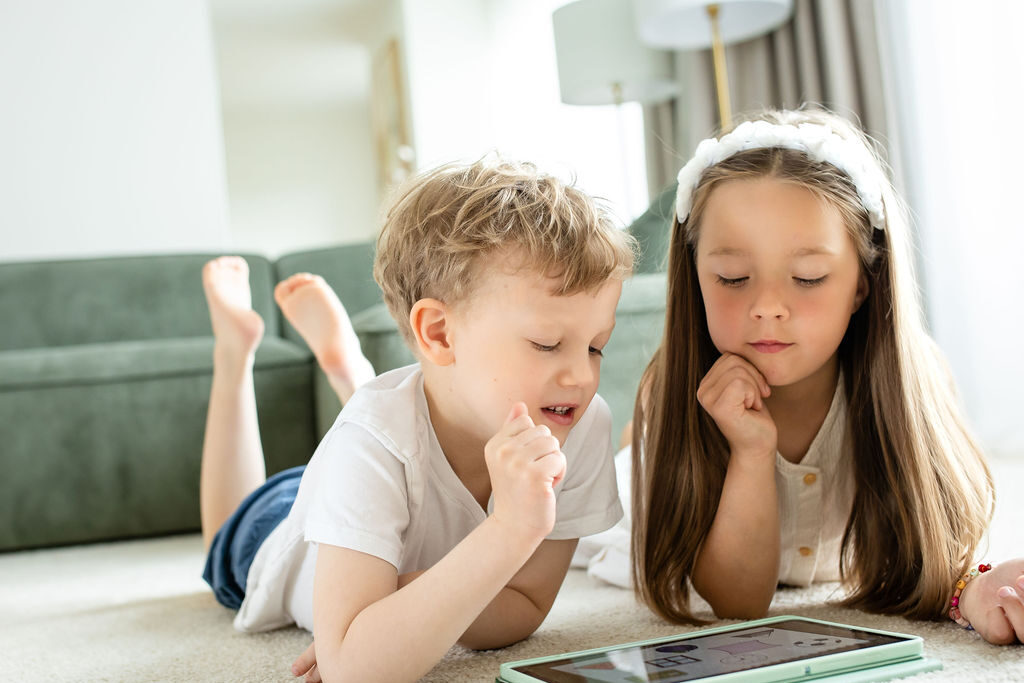
Some games are so easy that a child can tap through them while thinking about snacks and socks, all while the sofa is secretly a trampoline.
Other games are so hard that the child gives up before the learning even begins.
The best educational games for children live somewhere in the middle.
They feel possible, but not automatic. They give children an early little win, but still ask them to think. They leave room for mistakes, but not the kind of mistakes that make a child want to throw the tablet into another dimension.
That middle space is the sweet spot of early learning.
At ALPA Kids, this matters a lot. We do not want screen time to become passive tapping. We also do not want learning to feel like a tiny exam in a cartoon hat. The goal is calmer and smarter than that: a child listens, chooses, tries, gets something right, makes a small mistake, tries again and slowly builds confidence.
That is where learning starts to feel alive.
Why easy is not always better
Parents naturally like seeing their child succeed. Of course they do. A correct answer feels good. A proud little “I did it!” moment can melt even the most sleep-deprived adult heart.
But if every task is too easy, the child may not need to pay attention, remember, compare, choose or reason. They may be busy, but not necessarily learning much.
In the 2022 report AlpaKids data analysis (AlpaKids andmeanalüüs), the researchers Kristjan-Julius Laak and Jaan Aru analysed ALPA gameplay data and found that almost half of finished games had a perfect score.
That is a useful reminder for anyone designing meaningful early learning: perfect scores are nice, but they are not the whole goal.
For early learning, the better question is not “Can the child get everything right?” It is “Did the activity help the child think a little more than before?”
Tiny difference. Big learning energy.
Why too hard does not help either
Of course, the answer is not to make everything harder.
Children aged 3-8 are still building attention, memory, language, logic, confidence and emotional stamina. If a task becomes confusing too quickly, the child may leave the activity before they have had a real chance to engage.
The researchers Laak and Aru also found that successful completion was strongly associated with children getting at least three correct answers. They recommended that part of a game should be simple enough for the child to get an early success experience.
That early success matters.
It tells the child: “You can do this. Keep going.”
This is why good educational design is not about making children struggle for the sake of it. Struggle is not automatically learning. A frustrated child is not secretly becoming a genius because the app is confusing. Sometimes they are just annoyed, and honestly, fair.
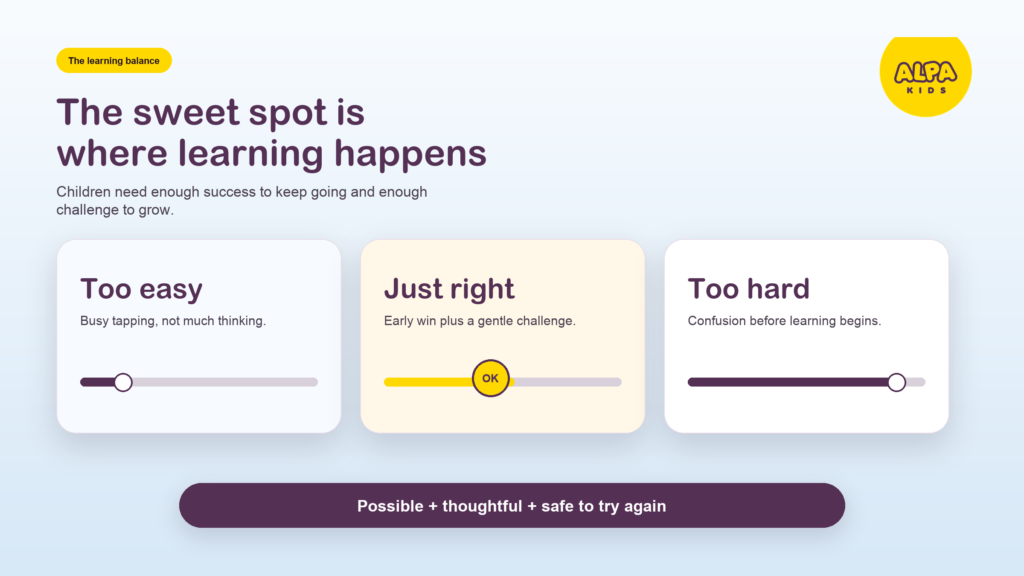
The sweet spot is different.
It gives children enough support to begin, then enough challenge to grow.
The sweet spot has two jobs
A good learning game should do two things at the same time.
First, it should help the child feel capable. That means clear instructions, familiar interaction patterns, warm feedback and a task that does not overwhelm them in the first few seconds.
Second, it should invite the child to stretch. That might mean remembering one more item, comparing two shapes more carefully, listening again, choosing between similar answers or trying after a small mistake.
This is where ALPA’s calm design matters. Children do not need a reward explosion every seven seconds. They need space to notice, think and try.
Think of the sweet spot like a learning bridge:
- Too easy: the child walks across without looking.
- Too hard: the child refuses to step on it.
- Just right: the child takes a careful step, then another, and feels proud at the other side.
Parent win. Brain win. Much less drama than the bridge metaphor deserves.
Mistakes are not the enemy
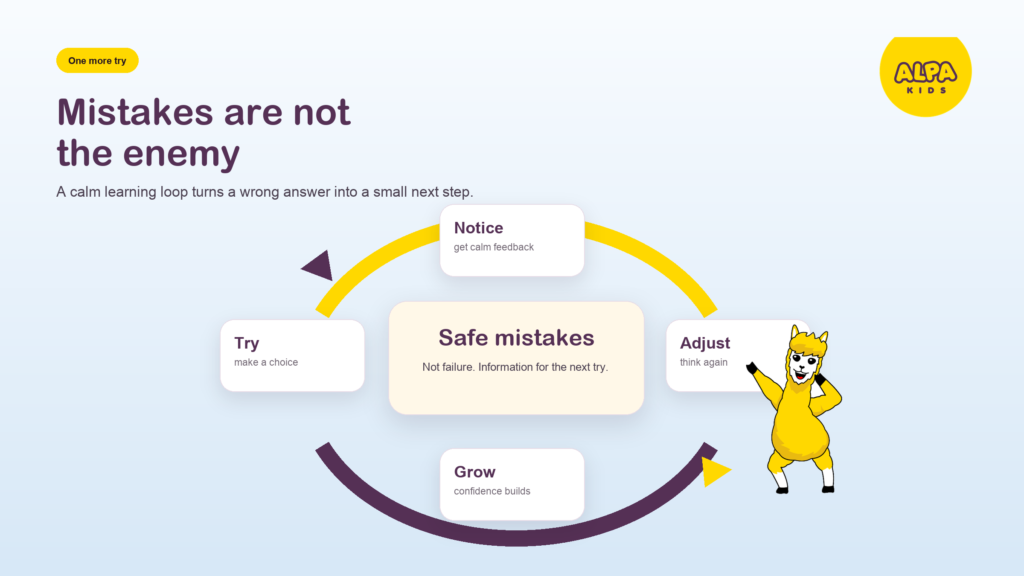
One of the most important ideas in early learning is this: mistakes are not failure. They are information.
A child who chooses the wrong shape, hears the word again and tries once more is doing real learning work. They are comparing. Adjusting. Remembering. Building confidence that a mistake is not the end of the world.
The final conclusion from Laak and Aru was beautifully practical: based on the available data, a successful game should be easy enough for the child to get at least three correct answers, but challenging enough that they make at least one mistake.
That is such a good sentence for parents.
Not perfect. Not impossible. Just enough challenge to make the brain wake up.
This is also why calm feedback matters. If an app treats mistakes like a loud buzzer emergency, children may avoid trying. If it treats mistakes as a normal part of play, children can stay curious.
At ALPA, that is the kind of learning moment we care about.
Short, focused and still meaningful
Laak and Aru also found that successful completion was associated with game durations of roughly 42-84 seconds. We should be careful here: this does not mean every game must be exactly that long, and it does not prove a universal rule for all children.
But it does support something parents and teachers often feel intuitively: young children usually do best with short, focused learning moments.
That is why ALPA often works well as a small learning ritual. Not an endless session. Not “just one more video” until everyone forgets what year it is. More like 10-15 calm minutes where the child plays a suitable level and practises early skills through active choices.
Short can still be meaningful.
A child can practise a new word in a minute. Compare shapes in a minute. Remember a pattern in a minute. Try again in a minute.
The magic is not in making screen time longer. The magic is in making it count.
What this means for parents
You do not need to become a learning scientist at breakfast. Truly. Mornings are already doing enough.
But you can use a simple filter when choosing educational screen time:
1. Does it give an early win?
Can your child understand what to do and experience success fairly quickly?
2. Does it ask for thinking?
Does your child need to listen, choose, remember, compare, solve or try again?
3. Does it make mistakes feel safe?
Can your child recover from a wrong answer without shame, stress or overstimulation?
4. Does it stay calm?
Is the pace helping your child focus, or is the app pushing speed, noise and constant reward loops?
If the answer is mostly yes, you are much closer to quality screen time.
How ALPA thinks about this
ALPA Kids is built to support active learning, not passive scrolling. That means children are not just watching things happen. They are doing small, meaningful learning tasks: listening, matching, choosing, remembering, comparing, sorting and trying again.
The sweet spot is part of that work.
If a level is too easy, the child may glide through it without much thinking. If it is too hard, the child may stop before learning has a chance to happen. But when the challenge is just right, the child gets both confidence and effort.
That is where screen time starts to feel less like “please let me survive this” and more like a small investment in early learning.
We cannot fix every bedtime negotiation.
But we can help make screen time calmer, safer and more purposeful.
A gentle next step
If your child already uses ALPA, try watching for the sweet spot next time:
- Which games feel easy and joyful?
- Which games make them pause and think?
- Where do they try again after a mistake?
- Which level feels right for their current development, not just their age?
And next time, if you use the full ALPA experience, check Learning Analytics too. It helps you see how your child is progressing, which types of games they are most drawn to and which areas might need a little support. Hello, little personality cues.
On the free plan, children can explore a smaller selection of games. The full ALPA experience opens all levels, games and bonus features, including Learning Analytics, which helps parents understand what their child is playing, enjoying and practising over time.
No pressure. No guilt. Just a smarter way to make screen time count.
FAQ section
Should educational games for children be easy?
Not always. Easy games can build confidence, but children also need gentle challenge to think, remember, compare and try again. The best learning games are possible, but not automatic.
Why are mistakes useful in early learning?
Mistakes help children adjust, remember and practise. When feedback is calm and supportive, a wrong answer can become a normal part of learning rather than a reason to give up.
How long should young children play learning games?
Short, focused sessions often work best. ALPA often fits well as 10-15 minutes of calm, meaningful early learning, especially when the child is ready to focus.
What makes ALPA Kids different from passive screen time?
ALPA Kids is safe, ad-free and calm by design. Children actively play educational games that support skills like language, maths, memory, logic, creativity, fine motor skills and school readiness.
How can parents choose the right level?
Choose by development stage, not only by age. A good level should give your child early success, but still ask them to think and try again.
Source note
This article is based on the 2022 report AlpaKids data analysis (AlpaKids andmeanalüüs) by Kristjan-Julius Laak (MSc) and Jaan Aru (PhD). The report analysed ALPA gameplay data and explored questions around scores, interruptions, game order, game duration and features associated with successful completion. Key points used here include the high share of perfect scores among finished games (9,963 finished games, 48.1%; pp. 2-3), the recommendation to support early success (p. 14), the association between successful completion and at least three correct answers (pp. 14-15), the association between successful completion and game durations of roughly 42-84 seconds (pp. 14-15), the short-duration interruption patterns (pp. 15-16), and the final conclusion that games should be easy enough for early success but challenging enough to include at least one mistake (p. 17).
References
Laak, K.-J., & Aru, J. (2022). AlpaKids andmeanalüüs [AlpaKids data analysis]. Unpublished data analysis report.