How calm feedback and one more go can build learning confidence.
When a child gets something wrong, the most helpful next step is rarely a big speech. Often, it is a calm moment, a small clue and the chance to try again.
Your child is sure the triangle goes in the circle-shaped hole.
It does not fit.
There is a small pause. A determined little hand. Then the look that says, “Well, that was rude.”
This is one of those tiny everyday moments that can go in a few directions. We can rush in with the answer. We can say “No, not that one.” Or we can give a child something much more useful:
“Almost. Let’s look again.”
That gentle invitation matters. Learning is not only about getting the right answer. It is also about noticing what happened, adjusting, and feeling safe enough to have another go.
For children aged 3-8, “try again” is not a consolation prize. It is a real learning skill.
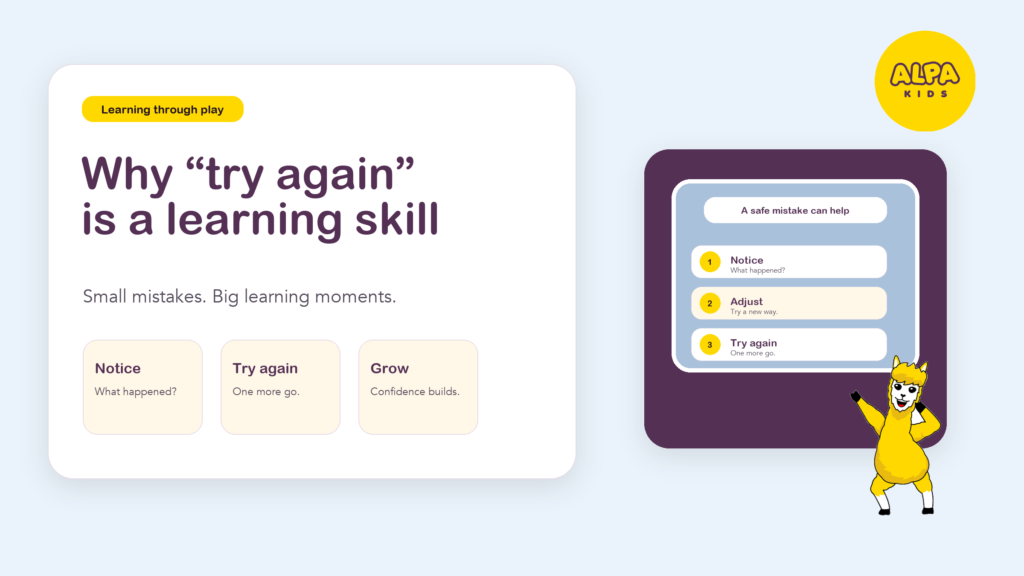
A mistake is a clue, not a stop sign
Children do not need a perfect streak of correct answers to learn. In fact, a task that is always easy gives them very little to work with. A small challenge can prompt a child to pay attention, remember, compare, listen again, choose differently and discover that they can work something out.
The important part is what happens next.
When feedback is clear and kind, a wrong answer becomes information. Not “you failed”, just “there is another way to look at this.” That is a very different feeling.
In a 2022 Tallinn University master’s thesis on personalised learning in Estonian preschools, Kippar (2022, pp. 26, 29-30) found that teachers valued ALPA’s immediate feedback and encouragement. They also preferred gentler language such as “needs repetition” rather than framing a child’s result as a list of mistakes. It is a small wording choice with a big human effect.
Children are wonderfully sensitive to the emotional weather around learning. If the moment feels rushed, loud or embarrassing, they may decide the task is not for them. If it feels calm and manageable, they are more likely to stay curious.
The calmer learning loop
Trying again is not about repeating the same thing with crossed fingers. It works best as a small loop:
- Try. The child has a go.
- Notice. Feedback helps them see what happened.
- Try again. They make one small adjustment.
- Grow. The next attempt feels a little more possible.
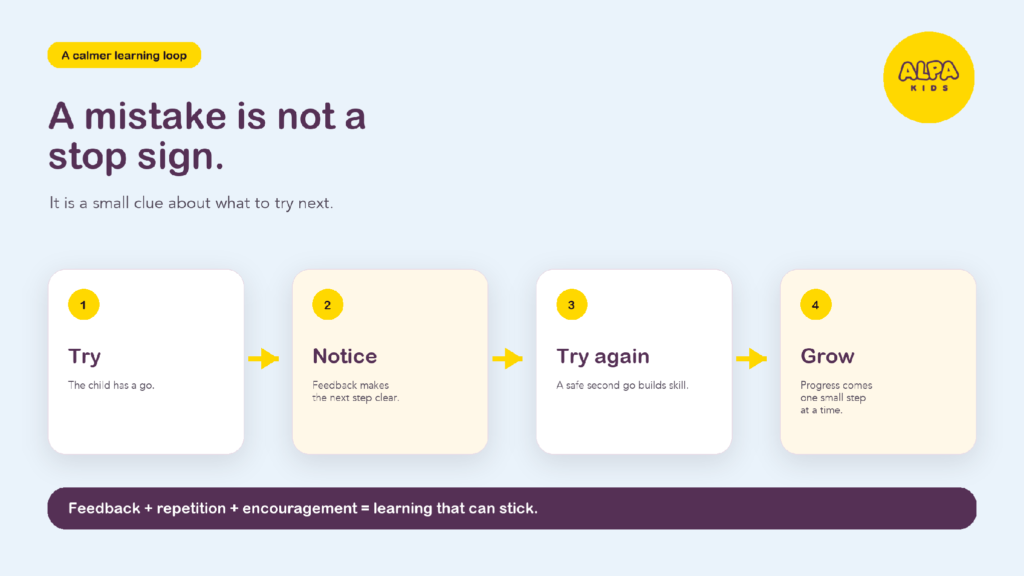
A calm learning loop: try, notice, try again and grow.
This is where good learning design earns its keep. A child should not be met with a dramatic buzzer, a noisy countdown or a digital confetti cannon for every tap. They need a clear next step, enough time to think, and feedback that helps rather than flusters.
Kippar (2022, pp. 23-24) also found that teachers used ALPA games to practise and revisit skills, and sometimes to get an informal sense of what a child already knew. That is an important distinction. Repetition is not a punishment for getting something wrong. It is how a child gets to meet an idea again with a little more understanding.
“I can’t do it” often means “not yet”
Parents know this moment well. A child gives up on a puzzle, a letter, a number or a game level after one difficult try. They may say, “I can’t do it,” with the full seriousness of somebody who has just been asked to file a tax return.
You do not need to turn the kitchen table into a motivational seminar. A small response is enough:
- “That one is tricky. Which part could we try first?”
- “You noticed it did not fit. What could you try instead?”
- “Want a clue, or would you like another go on your own?”
- “You kept thinking. That was a good try.”
These phrases do not pretend everything is easy. They show a child that effort, observation and another attempt all count.
The goal is not to make children endlessly cheerful about every challenge. Nobody is delighted by every difficult zip, shoe lace or upside-down puzzle piece. The goal is to help them build a calmer relationship with challenge itself.
Three ways to make “try again” feel safe
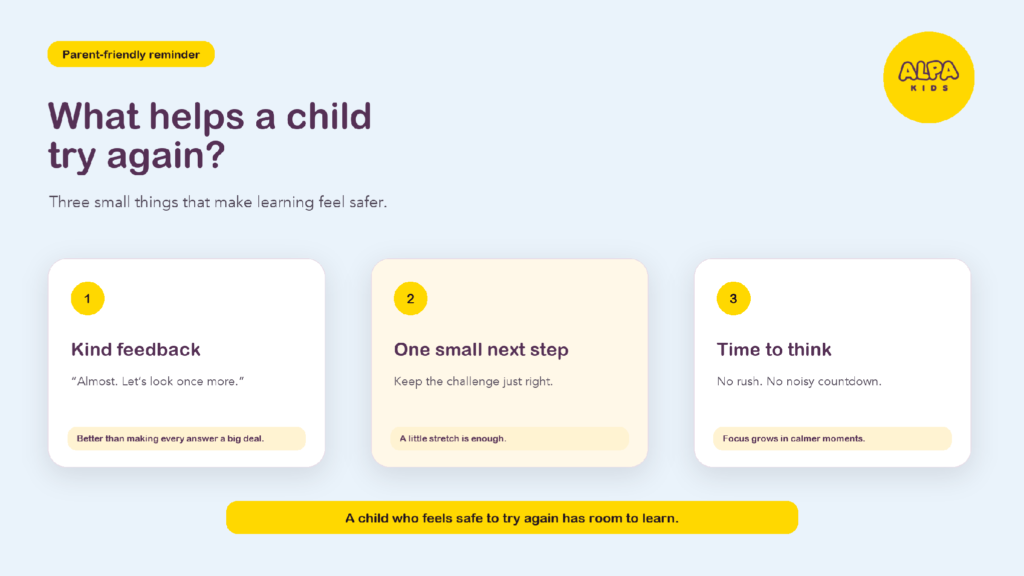
Three parent-friendly ways to make the next attempt feel safe.
1. Keep feedback kind and specific
“Good job” is lovely, but a child learns more from hearing what they actually did. Try “You listened carefully and changed your choice” or “You found a new way to solve it.” This helps them connect effort with the next step.
2. Make the next step small
If a task feels huge, shrink it. Find one matching piece. Listen to the first sound. Count two objects, not ten. A manageable challenge gives children a reason to stay in the game.
3. Leave room to think
Silence is not a problem to solve. Give your child a moment before offering the answer. That little pause is often where the learning happens, even if it looks suspiciously like staring at a sock.
What this looks like in ALPA
ALPA games are designed to give children a playful place to listen, choose, practise and try again. The focus is not on making a child feel tested. It is on helping them build early skills through calm, age-appropriate play.
The research behind this article included teachers who were already active ALPA users. In that study, teachers appreciated the ability to choose games by topic, difficulty and the individual child. They also saw potential in tools that make progress easier to notice over time (Kippar, 2022, pp. 25-26).
ALPA is one helpful part of a wider early-learning picture. It complements the conversation, books, movement, real-world play and caring adults that help children learn every day.
A gentle next step
Next time your child gets something wrong, try making the moment a little smaller.
Take a breath. Name what they noticed. Offer one clue. Then leave room for another go.
“Try again” is not pressure. It is permission.
And every now and then, that permission becomes the quiet little voice that says, “I think I can do this.”
No pressure. No guilt. Just one more small chance to learn.
What does the research say about ALPA Kids?
Kippar (2022, pp. 21, 25-26) surveyed 21 teachers who used ALPA in Estonian preschools and interviewed four education specialists. They valued the games’ curriculum connection, level progression and potential to support observation of children’s learning.
References
Kippar, E.-M. (2022). Personalized learning in early childhood education in Estonia and opportunities to support it through technology: Using ALPA Kids application [Master’s thesis, Tallinn University].
FAQ
Trying again gives children practice in noticing what happened, adjusting their approach and building confidence through effort. It helps them learn that a difficult first attempt does not decide what they can do next.
Keep your response calm, kind and specific. Name what they noticed, offer one small clue if they want it, and give them time to think. Avoid making a wrong answer feel like a big event.
Yes, when it stays playful and purposeful. Revisiting a skill gives children another chance to understand it, especially when the level of challenge feels manageable.
They can support the process when they offer clear feedback, suitable levels and calm opportunities to try again. They work best alongside everyday play, conversation and adult support.
Kippar (2022, pp. 21, 25-26) surveyed 21 teachers who used ALPA in Estonian preschools and interviewed four education specialists. They valued the games’ curriculum connection, level progression and potential to support observation of children’s learning