hoosing educational apps for preschoolers can be tough. Search for educational apps and you will find thousands of options. Some promise reading, others focus on maths, creativity or school readiness. Many look educational because they use bright colours, friendly characters and cheerful rewards.
But appearance tells you little about what a child is learning.
The better question is not, “Which educational app is best?” It is:
What skills would I like my child to develop?
No single app can teach everything. One may be excellent for literacy but offer little creative freedom. Another may strengthen problem-solving without teaching letters or numbers. Strong apps often complement one another because they support different parts of development.
This guide explains how to assess an app’s educational value and compares five preschool apps that each do something particularly well.
What does school readiness actually mean?
School readiness is about more than recognising letters, counting to ten or writing your name.
Children also need opportunities to develop:
- language and communication;
- early numeracy and pattern recognition;
- concentration and self-control;
- problem-solving and persistence;
- curiosity and confidence;
- creativity, storytelling and imagination.
These abilities overlap. A child building a tower may practise counting, planning and persistence at the same time. A child inventing a story may develop vocabulary, emotional understanding and flexible thinking.
So do not judge an app only by whether it teaches the alphabet. Ask: Which area of development does this app strengthen?
How can you tell if an app is truly educational?
Before downloading an app, consider these seven questions.
1. Does it encourage active thinking?
High-quality apps ask children to decide, solve, create, compare or experiment. Lower-quality apps may only reward quick tapping or repeated actions.
A good sign is that your child pauses to think. A warning sign is that progress depends mainly on reacting quickly or collecting rewards.
2. Does it develop a meaningful skill?
You should be able to explain what the activity practises, whether vocabulary, number sense, sequencing, creativity or spatial reasoning.
Ask: If my child used this app regularly, what would improve? If the answer is unclear, it may be entertaining without being especially educational.
3. Does it leave room for curiosity?
Some apps guide children towards one answer. Others invite them to test ideas and ask, “What happens if I try this?”
Both approaches can be useful, but strong learning experiences should include room for experimentation rather than directing every tap.
4. Is it appropriate for your child’s stage?
An app that is too easy becomes repetitive. One that is too difficult becomes frustrating.
Good apps offer manageable challenges, clear instructions and enough success to keep children engaged without removing the need to think.
5. Does learning continue after the screen turns off?
Valuable apps inspire activity beyond the device. A counting game may lead to counting fruit at the supermarket. A building activity may inspire a bridge made from blocks. A storytelling app may continue as pretend play.
Quality screen time should connect with real life rather than replace it.
6. Can your child learn in their strongest language?
Young children often understand new ideas most easily through familiar language and examples. Native-language learning can support confidence, vocabulary and the ability to connect digital activities with everyday life.
This matters particularly for literacy and other foundational concepts.
7. Does the app respect your child’s attention?
Look for excessive advertising, constant interruptions, manipulative rewards, pressure to buy extras or design choices intended mainly to prolong use.
A learning app should measure success by what the child understands or creates, not simply by time spent on-screen.
How we selected these five apps
We chose apps that encourage active participation, suit preschool-aged children and have a clear purpose. Each also needed to contribute something different.
This is not a ranking. It is a selection of five apps with distinct strengths.
1. ALPA Kids
Best for broad school readiness
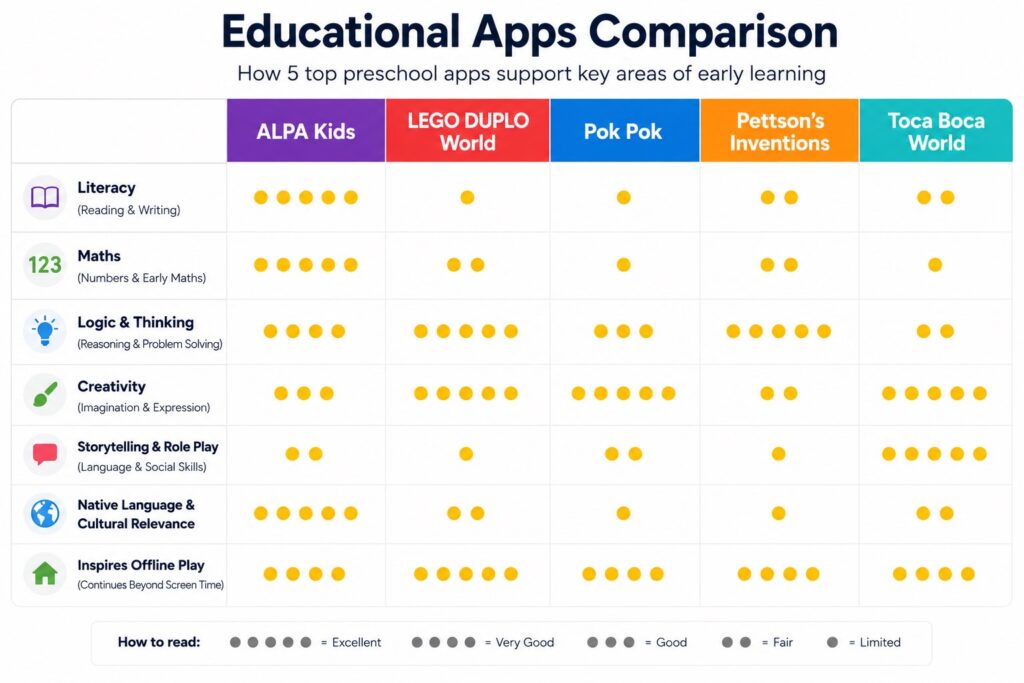
ALPA Kids combines early literacy, mathematics, logical thinking, nature, vocabulary and creativity in one learning environment. It is the broadest all-rounder here and is relevant for families seeking structured preparation across several foundational skills.
Its clearest differentiator is its local-first approach. ALPA develops content around local languages, educational contexts and culturally familiar examples. The app is available in Estonian, Latvian, Lithuanian, Polish, Ukrainian, English, Swedish, Danish, Brazilian Portuguese and Hindi.
Several university theses have examined ALPA in educational settings. Teachers have described it as useful for reinforcing classroom learning, vocabulary, repetition and independent practice. A 2024 Tallinn University thesis also found, that purposeful app use created opportunities for independence, communication, cooperation and problem-solving. The research emphasised that environment, activity format and adult support still matter.
Best suited to: broad school readiness, native-language learning and families seeking one app that covers several learning areas.
2. LEGO DUPLO World
Best for creativity and early STEM
LEGO DUPLO World focuses less on memorising facts and more on constructing, experimenting and observing.
Children solve simple challenges, build objects and explore cause and effect. These activities can support spatial reasoning, early engineering thinking and persistence. Its main advantage is the connection between digital and physical play. A child who builds something on-screen may want to recreate it with real bricks.
Best suited to: children who enjoy building, experimenting and practical problems.
3. Pok Pok
Best for curiosity and open-ended exploration
Pok Pok provides open-ended digital toys rather than levels, quizzes or fixed goals.
Children explore, combine objects and invent their own ways to play. This can support curiosity, flexible thinking, decision-making and independent exploration. Its calm design, lack of advertising and limited use of external rewards suit families seeking a less stimulating digital experience.
Best suited to: curious children who enjoy experimenting without constant instructions.
4. Pettson’s Inventions
Best for logic and problem-solving
Pettson’s Inventions asks children to assemble simple mechanical solutions from different components.
The puzzles encourage observation, sequencing, planning and persistence. Children often need to test several ideas before finding a solution, making mistakes part of the activity rather than something to avoid.
The app can also prompt parent-child conversation as children explain why a component belongs in a certain place.
Best suited to: puzzle lovers and children interested in how things work.
5. Toca Boca World
Best for storytelling and imaginative play
Toca Boca World is less academic than the other apps here, but that does not make it less valuable.
Children create characters, arrange spaces and invent stories. This open-ended role play can support language, creativity, emotional expression and social understanding.
There are no single correct answers. The child becomes the author rather than simply following instructions.
Best suited to: children who enjoy pretend play, characters and storytelling.
Which app is right for your child?
| If your child… | Consider… |
| Is preparing for school across several subjects | ALPA Kids |
| Loves building and experimenting | LEGO DUPLO World |
| Constantly asks “Why?” | Pok Pok |
| Enjoys puzzles and mechanisms | Pettson’s Inventions |
| Loves stories and pretend play | Toca Boca World |
Two complementary apps may work better than several similar ones. ALPA Kids and Toca Boca World combine structured learning with imaginative play, while LEGO DUPLO World and Pettson’s Inventions approach problem-solving from different angles.
Five warning signs an app may not be very educational
Be cautious if an app:
- rewards endless tapping rather than thinking;
- interrupts activities with frequent advertisements;
- relies mainly on animation and sound to hold attention;
- gives children no room to explore or choose;
- entertains without a clear skill or learning purpose.
Final thoughts
Parents often ask which educational app is best. That still seems like the wrong question.
A better question is: What skills do I want my child to develop?
Choose ALPA Kids for broad foundational learning, LEGO DUPLO World for building and STEM, Pok Pok for curiosity, Pettson’s Inventions for logic, or Toca Boca World for storytelling.
The most valuable educational app is not the one that keeps a child occupied longest. It is the one that helps them notice, build, count, question, solve or imagine after the screen is switched off.
Frequently asked questions
What is the best educational app for preschoolers?
There is no single best app for every child. The right choice depends on the skill you want to support and your child’s interests and developmental stage.
How many educational apps does a preschooler need?
One or two well-chosen apps are usually enough. Children often benefit more from meaningful engagement with a few strong options than from constantly switching between many apps.
Can educational apps replace preschool or kindergarten?
No. They work best alongside books, conversations, outdoor play, creative activities and interaction with parents, caregivers and teachers.
Is native-language learning important?
For many preschoolers, yes. Familiar language helps children connect new concepts with everyday experiences and can strengthen confidence before they learn in additional languages.