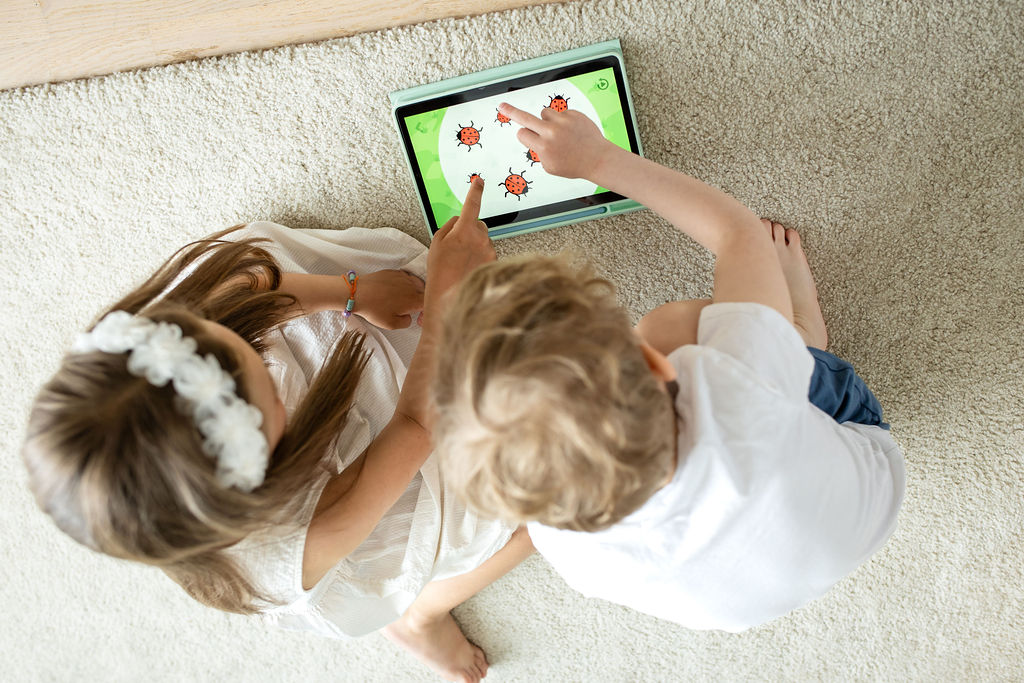
There is screen time that leaves a child glazed over, snack crumbs nearby, somehow watching a video of another child opening a toy they do not own.
And then there is screen time where a child listens, thinks, chooses, tries again, remembers a new word, solves a tiny puzzle and proudly announces, “I did it!”
Same device. Completely different experience.
That difference matters. Especially for children aged 3-8, when early language, memory, attention, logic, fine motor skills and confidence are growing at remarkable speed. The question is not only “How much screen time?” It is also “What kind of screen time?”
At ALPA Kids, we believe children deserve digital experiences that are calm, safe and genuinely educational. Not passive scrolling. Not noisy speed-loop games. Not a tiny circus in tablet form.
Quality screen time should help a child do something meaningful.
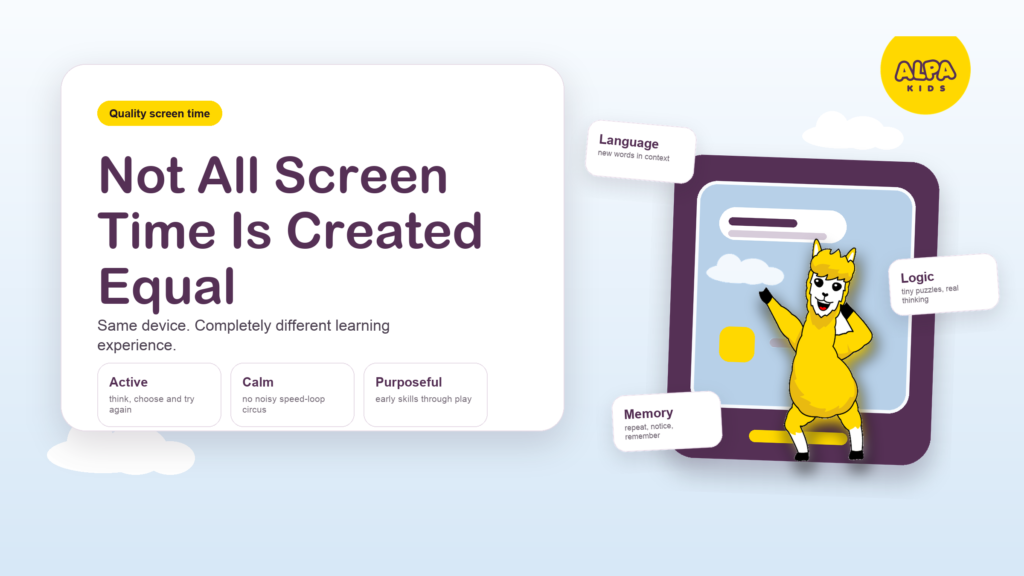
What Is Quality Screen Time?
Quality screen time is screen time where the child is actively involved in learning. They are not just watching. They are listening, choosing, matching, solving, repeating, noticing, remembering and trying again.
In other words, the screen is not the babysitter. The screen is the learning environment.
That is an important difference.
A 2024 Tallinn University master’s thesis by Mari Kummer studied how Estonian screen-based educational apps can be used in kindergarten, using ALPA Kids in observed activities with children. The study looked at practical questions that parents and teachers actually care about:
- What kind of environment helps children focus?
- Can educational apps support independence?
- What role does the adult play?
- Can screen-based activities support cooperation, communication and problem-solving?
The key takeaway was beautifully practical: educational app use works best when it is intentional. The app matters, yes. But so do the pace, the environment, the activity and the adult support around it.
Tiny detail, big difference.
The Screen Is Not The Whole Story
When parents worry about screen time, they are usually not worried about pixels. They are worried about what the screen is doing to their child.
Is it overstimulating them?
Is it replacing play?
Is it making bedtime negotiations even more dramatic than usual?
Is their child learning anything, or just tapping until the battery gives up?
Fair questions. Very fair.
But lumping all screen time into one big suspicious bucket is not very helpful. A video autoplay loop, a loud reward-heavy game and a calm educational activity are not the same thing.
In Kummer’s study, ALPA Kids was used in structured kindergarten activities. The research found that children could act independently because the app was visual and understandable, but adult guidance still helped keep the activity purposeful. That is a strong reminder: quality screen time is not about leaving children alone with a device and hoping for the best.
It is about giving them a better digital space to learn in.
Passive Screen Time Vs Active Learning
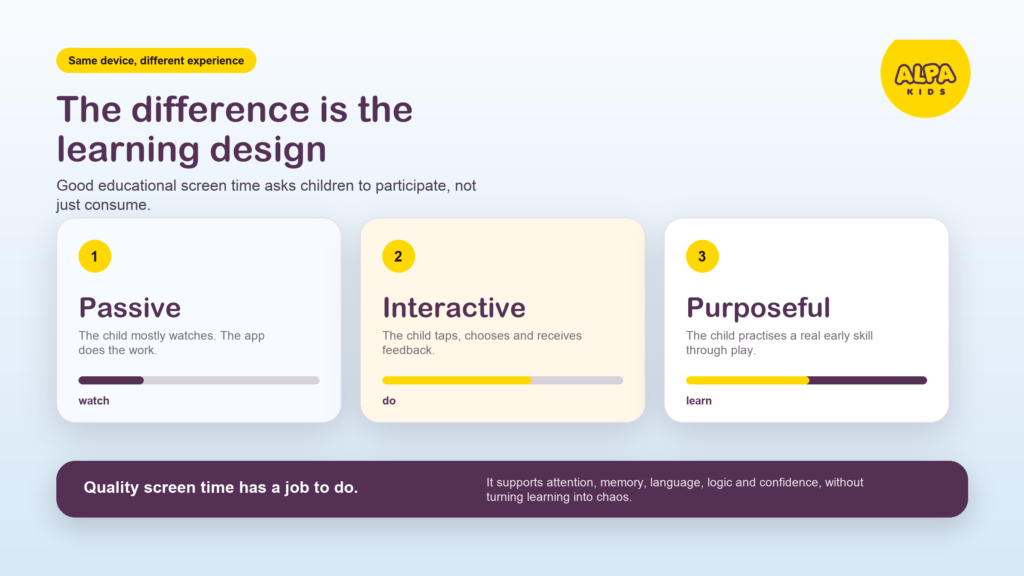
Passive screen time asks very little from the child. Watch this. Swipe this. Next video. Next sound. Next tiny dopamine biscuit.
Active learning asks the child to participate.
They might hear a word and match it to an object. Compare sizes. Choose the right shape. Remember a pattern. Trace a letter. Solve a logic task. Repeat a sound. Try again after a mistake.
That is where screen time starts to look less like digital noise and more like a small learning workout.
Think of it as screen broccoli. The kind children actually ask for.
For young children, this matters because early learning is not only about “knowing things”. It is about building habits of attention, memory, curiosity and confidence.
A good educational app should support those habits by giving the child:
- clear instructions
- age-appropriate challenges
- gentle repetition
- positive feedback
- room to make mistakes
- a reason to think before tapping
That is the difference between a child consuming content and a child doing something with it.
Calm Design Is Not A Small Thing
One of the most interesting parts of Kummer’s research was how much the environment mattered. Children focused better in a calm space with fewer distractions. The study also showed that different activity setups worked differently: one child with one device, two children sharing, small group work, table work, floor work, headphones, no headphones.
This might sound like a teacher-only detail, but parents can use it too.
Quality screen time becomes easier when the moment around it is calmer:
- choose a quieter corner
- keep the session short
- avoid loud background TV
- make sure the child can hear the instructions
- use the app when the child is ready to focus, not already wildly overtired
We cannot promise this will prevent every tantrum. We are an educational app, not a wizard.
But we can say this: a calmer learning setup gives children a better chance to actually engage with what they are doing.
That is why ALPA is calm by design. The pace, colours, feedback and activities are created to support learning, not frantic tapping.
The Adult Still Matters
Here is a truth we like very much: educational technology works best when it respects the adult, not when it pretends to replace them.
Kummer’s thesis found that teacher guidance helped children use the app purposefully. Adults helped choose suitable activities, keep children focused, support problem-solving and make sure the digital activity stayed connected to the learning goal.
For parents, this does not mean you need to sit beside your child for every second. Real life exists. Dinner exists. Emails exist. Someone has to find the missing sock.
But a small amount of adult involvement can make screen time better:
- help your child choose the right level
- ask what they played
- notice what they enjoyed
- celebrate effort, not only correct answers
- use progress insights when available
That last part is important. When a child plays, there is often more happening than we can see from the outside. What topics do they return to? What feels easy? Where do they need more practice? What sparks curiosity?
This is where learning analytics can become genuinely useful for parents. Not as pressure. Not as a report card for a 5-year-old, thank you very much. More like a small window into your child’s learning journey.
Three Signs Of Quality Screen Time
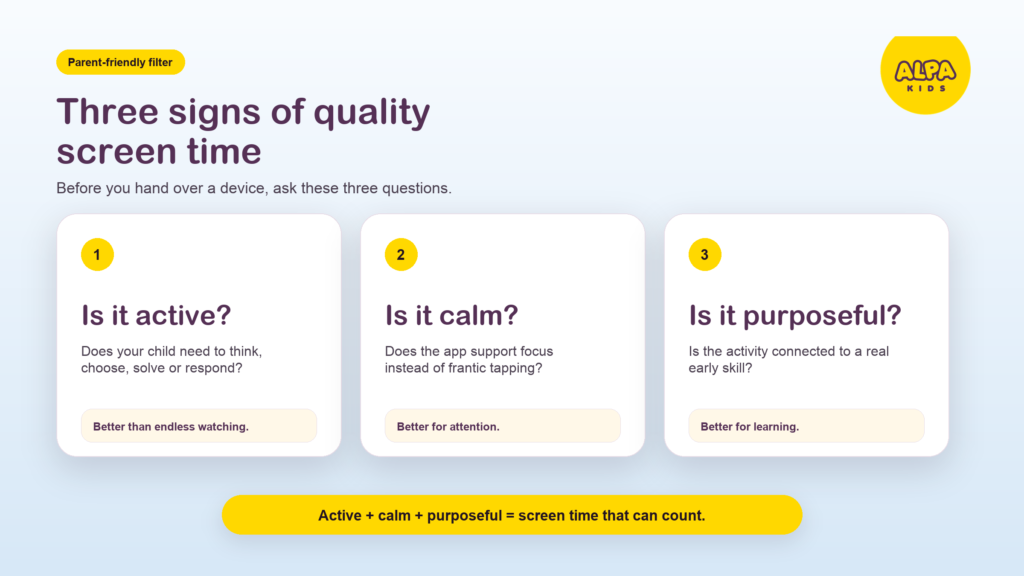
If you want a quick parent-friendly filter, ask these three questions:
1. Is It Active?
Does your child need to think, choose, solve, repeat or respond? If yes, that is already a better sign than endless watching.
2. Is It Calm?
Does the app support focus, or does it push constant speed, noise and overstimulation? Children do not need digital fireworks every seven seconds to learn.
3. Is It Purposeful?
Is the activity connected to early skills like language, maths, memory, logic, fine motor skills, creativity or school readiness? Good screen time has a job to do.
That job can still be playful. In fact, for young children, play is often the best doorway into learning.
So, Should Children Use Screens?
The honest answer is: screens are already part of children’s lives. The more useful question is how we help children build healthier, smarter relationships with them.
That means choosing digital experiences that are safe, ad-free, calm and built for active learning. It means remembering that the best educational apps do not replace real-world play, books, movement, conversation or muddy knees. They add one more meaningful tool to the early learning toolbox.
ALPA Kids was built with teachers, researchers and educators because children deserve better than random screen time. They deserve learning that feels playful, safe and connected to the world they actually live in.
So no, not all screen time is created equal.
Some screen time is just screen time.
And some screen time helps a child practise a new word, solve a small challenge, notice a pattern, try again after a mistake and feel that tiny, glowing “I can do this” feeling.
That is the kind we are here for.
A Gentle Next Step
If ALPA is already part of your child’s day, try treating it like a small learning ritual: 10-15 calm minutes, one suitable level, and a little curiosity afterwards.
“What did you play today?”
“What was easy?”
“What was tricky?”
“Show me your favourite one.”
On the free plan, children can explore a smaller selection of games. The full ALPA experience opens all levels, games and bonus features, including Learning Analytics, which helps parents understand what their child is playing, enjoying and practising over time.
No pressure. No guilt. Just a smarter way to make screen time count.
FAQ
No. Screen time quality matters. Passive, overstimulating content is very different from calm educational screen time where children actively listen, choose, solve, repeat and lear
Quality screen time is digital activity that supports active learning. For children aged 3-8, that can include language, maths, logic, memory, creativity, fine motor skills and school readiness activities.
ALPA Kids is safe, ad-free and calm by design. Children actively play educational games instead of passively scrolling or watching autoplay content.
A short, focused session is best. ALPA often works well as 10-15 minutes of meaningful early learning, especially when the child is calm and ready to focus.
Yes. The full ALPA experience includes Learning Analytics, which helps parents understand what their child played, what interests them and how their learning develops over time.
Source Note
This article is inspired by Mari Kummer’s 2024 Tallinn University master’s thesis, “Eestikeelsete ekraanipõhiste haridusrakenduste kasutamise võimalused lasteaias”. The thesis used ALPA Kids in kindergarten-based action research and explored how screen-based educational apps can support purposeful learning, independence, cooperation, communication and problem-solving in early childhood settings.