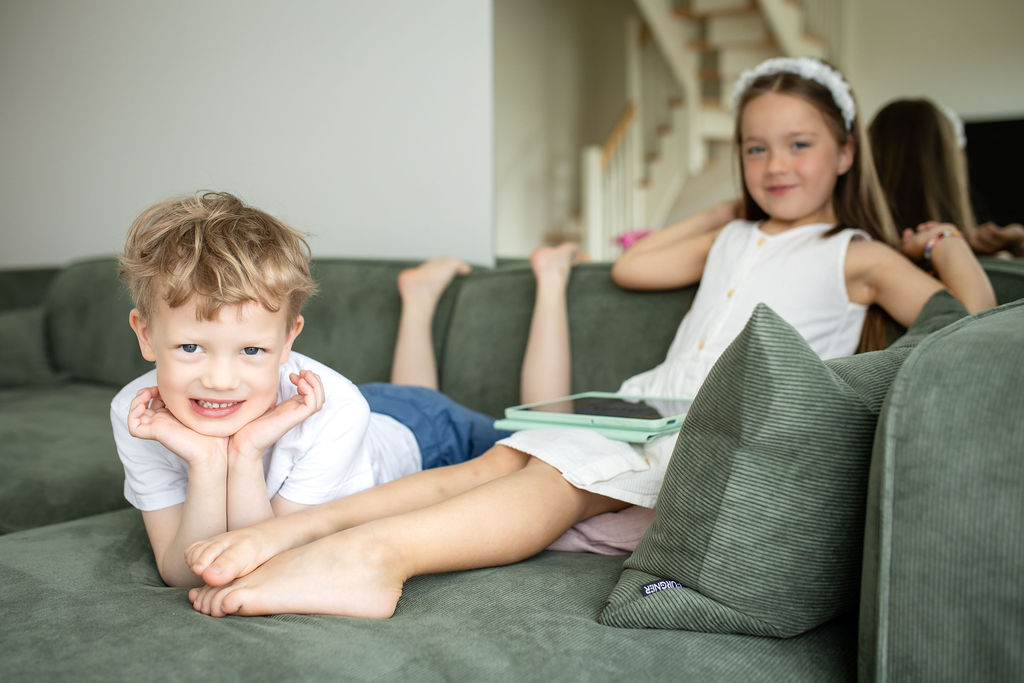
A child is stuck on a puzzle, nearly there, but not quite. They are losing motivation but then the final piece clicks and a cheerful voice says “Good job”, and the child immediately wants to do it again. It looks like a tiny moment – a kind word, and we go on to the next thing. But that tiny moment is doing more work than it seems. And we are not the only ones who think so.
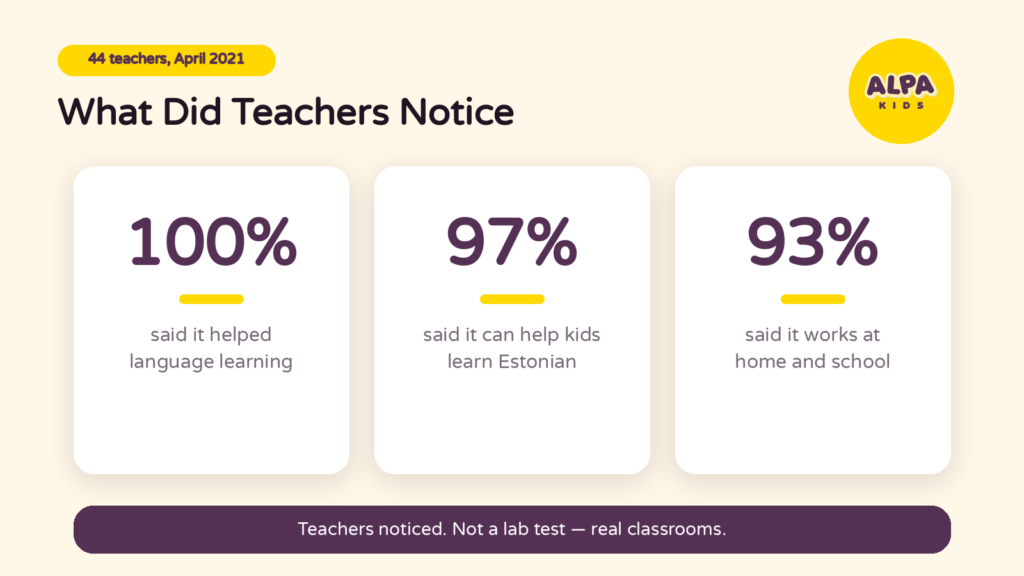
In 2021, a Tallinn University researcher named Abdelsalam Megahed set out to answer a question every parent quietly wonders about: does learning through play on a screen actually help young children, or does it just keep them busy? To find out, he surveyed 44 preschool teachers who had been using ALPA Kids in their classrooms.
Their answers were surprisingly consistent. And a lot of what they described came back, again and again, to how a child feels when they get something right.
Learning through play
The survey set out to answer a simple question: were children really learning something from playing games, or was it just entertainment that happened to look educational? For months, teachers used ALPA Kids in their everyday lessons, and when they described what changed in the classroom, the same details kept coming up. Children stayed motivated and asked to play again, even ones who had not been especially interested in learning before. Teachers noticed stronger vocabulary, better pronunciation, and more confident listening, reading and writing, built up through repetition and the app’s step-by-step feedback. Mistakes stopped feeling like a big deal, since children could simply try again and, teachers said, felt good about the process rather than discouraged by getting something wrong . Taken together, all 44 teachers said ALPA had a positive impact on their students’ language learning.
One finding stood out even more. About 98% of teachers said ALPA specifically helped children from Russian-speaking homes keep up with the state language. So this was not only a tool that supported the whole class. For the children who usually struggled to keep pace, it was a genuine boost.
The Quiet Power Of “Good Job”
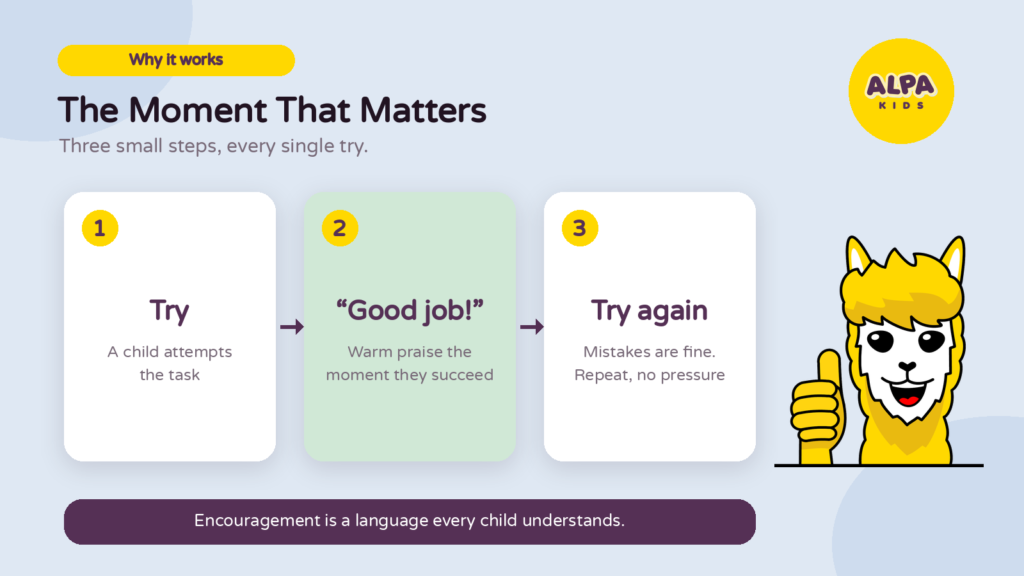
When teachers explained what actually helped, they kept describing the same thing in different words: the way the app responds the moment a child does something right.
Here is what teachers connected it to: praise after finishing a task, they reported, gives children “a lot of positivity and confidence” and raises their self-esteem, and it even sparks interest in children who were not especially keen on learning to begin with. A child who did not care much about learning leans in, not because the app got louder or faster, but because it made them feel capable.
Mistakes Are Allowed Here
Teachers also noticed something quieter: children could get something wrong and simply try again. The app lets a child repeat a task as many times as they like, and teachers said this helped children feel good about the whole process rather than bad about a single mistake
This is a bigger deal than it sounds. A lot of early learning is really about one thing: whether a child is willing to try something hard, get it wrong, and have another go. A learning space where mistakes are no big deal is a learning space where children take risks. And risk-taking is where the real growth happens.
So the emotional design is doing two jobs at once. “Good job” says you can do this. And the freedom to retry says and it’s fine if you can’t yet. Together, that is a remarkably kind way to learn.
Let Alpaca Be Your guide
Part of why all this lands is that a child is not being praised by a cold machine. They are being guided by ALPA, the app’s alpaca character.
Teachers highlighted how much the character mattered, especially for children from language minorities. ALPA explains each game out loud, then praises the child after every success. For a child learning a new language, that turned out to matter more than expected: ALPA never judges and gives an unlimited number of attempts with no pressure. Because ALPA speaks, explains and encourages entirely in the target language, teachers said the games stayed understandable even for a child who did not speak it yet, which kept their attention on listening and trying instead of giving up.
A friendly voice that says “here’s what to do” and then “well done” is a very old teaching idea. It works with a warm adult in a classroom. It turns out it works with a cheerful alpaca on a tablet too.
What You Can Try At Home
You do not need an app to use the best idea in this whole study. The “good job” principle works just as well at the kitchen table.
A few small things worth stealing:
- Praise the effort, not the child. “You kept trying even when it was tricky” tends to build more resilience than “you’re so clever”. It tells a child that trying is the win.
- Make mistakes boring. The calmer you are about a wrong answer, the more willing your child is to have another go. “Nearly! Try again” is a full sentence.
- Celebrate the small finish out loud. The moment they get it, say so. That little burst of recognition is exactly what those teachers were describing.
- Let them repeat things. Children love doing the thing they just mastered, again and again. That is not boredom. That is confidence being rehearsed.
None of this is about pressure or performance. It is about making a child feel safe enough to try, and proud enough to keep going.
So, What Did 44 Teachers Really Notice?
They noticed that when children feel encouraged, they lean into learning. When mistakes are allowed, they take chances. When a friendly voice says “good job”, they believe they can do the next thing too. When we make kids feel capable, safe, and cheered on, they are eager to learn.
That is what ALPA is built around, on purpose. Calm, encouraging, mistake-friendly, and made with teachers, researchers and psychologists who understand small children. And that’s why it really works and helps kids to learn. Sometimes the most powerful thing a learning tool can say to a child is the simplest.
FAQ
In a 2021 Tallinn University survey, all 44 preschool teachers reported that ALPA Kids had a positive impact on children’s language learning. It is important to read this as experienced teachers’ observations rather than a laboratory measurement, as the study itself notes its small sample and survey-based design. Within those limits, the teacher feedback was strongly positive.
Teachers in the study reported that praise after completing a task gave children positivity, confidence and higher self-esteem, and even sparked interest in children who were previously reluctant to learn. Encouragement helps children feel capable, which makes them more willing to keep trying.
Children receive warm, immediate praise when they succeed, such as stars and a spoken “Good job” at the end of a puzzle or balloons after a challenge. The friendly alpaca character, ALPA, explains each game and cheers children on.
Yes, and that is part of the design. Teachers noted that children can repeat tasks and try again after mistakes, helping them feel positive about the learning journey rather than discouraged by errors.
In the survey, 97 % of teachers who take part in the survey believed ALPA could help Russian-speaking children learn the national language, partly because the encouraging character and clear feedback made a new language feel approachable. As with all findings here, this reflects teacher perceptions rather than measured test results.
Source Note
This article draws on Abdelsalam Megahed’s 2021 Tallinn University master’s thesis, “Impact of Language Learning Games for Preschool Children Based on the Case Study of Alpa Kids Application” (School of Digital Technologies, supervised by Linda Helene Sillat, MSc). The study surveyed 44 preschool teachers from 37 kindergartens and preschools in April 2021 about their experience using ALPA Kids. It is a qualitative, teacher-perception study with a small sample, and the author notes these limitations directly, so its findings are best understood as informed classroom observations rather than broad, cause-and-effect proof.